
Survey first: $300–$750
A recorded camera run with distances marked. Yours to keep, and usually credited if the work goes ahead.
A cracked or root-damaged drain does not have to mean a trench through the garden. A resin liner is cured inside the existing pipe from an access point you already have, sealing every joint along the run, and the surface above is never touched.
Relining is a structural repair, not a cleaning method, and the distinction matters when you are comparing quotes. Jetting restores flow through a pipe that is still cracked. A liner restores the pipe.
That also means it is not always the answer. It cannot correct a run that has sagged or lost its fall, and it has nothing to line against where a section has collapsed. A camera survey separates those cases in about an hour, and the answer changes the cost by a multiple.
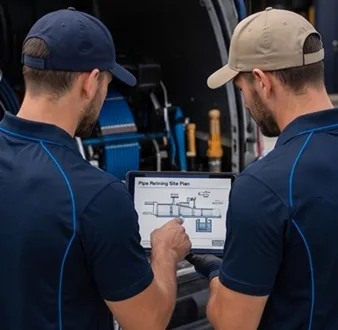
Homes from Engadine’s 1950s–70s expansion still run original earthenware pipework that cracks and sags after decades on shifting sandstone ground.
Houses of this era were generally drained in vitrified clay, laid well, and then left alone for sixty or seventy years. The pipe is usually still round and still sound. The joints have had seven decades of ground movement and root pressure.
That combination is close to the textbook relining case, which is why so much no-dig work in Sydney happens on streets built between the late 1940s and the 1960s.
On a clay line the barrel is usually fine. What has gone is the mortar or rubber ring at each joint, and there is one every few hundred millimetres, which is a great many small openings after sixty or eighty years in the ground.
Towering gums along Engadine’s streets and reserves drive roots deep into ageing clay sewer joints, far and away the suburb’s top blockage cause.
That matters for the quote. You are not replacing a pipe, you are sealing a long series of joints, and a liner does the whole run at once rather than patching them one at a time.
Thin soils over sandstone shed rain almost instantly toward gullies like the Forbes Creek line, surging through stormwater drains during downpours.
Most people associate relining with sewers, but stormwater suffers the same failures and reline just as well: cracked lengths, open joints, roots, and sections that have silted because the fall has flattened. On a property that floods in every serious downpour, the line is often the reason rather than the rain.
The camera run matters more here than anywhere. Clearing a surcharging pit at the height of a storm tells you almost nothing; the same line inspected on a dry day tells you whether you have a blockage or a defect.
Removing a mature tree is expensive, often needs approval, and frequently does not solve it: the roots already inside the pipe do not leave when the trunk does, and the joint is still open for the next one.
Engadine anchors the southern end of Sydney’s Sutherland Shire (postcode 2233), a sandstone-plateau suburb bordered by Heathcote, Yarrawarrah and Woronora Heights with the Royal National Park at its doorstep. Its post-war housing stock and gum-lined streets make tree-root drain blockages an everyday event.
Relining lets both things be true at once. The garden stays as it is and the drain stops being a route to water. For most owners that is the whole appeal, and it is why no-dig gets specified on established blocks far more often than on new ones.
People are often surprised that a drain laid before the war is a relining candidate rather than a replacement. Age alone does not decide it. A clay line with a sound barrel and tired joints is close to the best case for a liner.
The cases that genuinely need excavation are different: a collapsed section, a run that has lost its fall, or a pipe crushed out of round. A camera separates those in an hour, and the answer changes the cost by a multiple.
The most expensive time to discover a failing sewer is after new tiling has gone down. The second most expensive is after the slab for an extension has been poured over it.
A camera run costs a fraction of either and takes an hour. If you are getting quotes for a renovation on a house of this age, book it in the same fortnight. Where relining is needed it is far cheaper before the works than after.
Relining is priced per metre and the honest comparison is never liner against nothing. It is liner against excavation plus everything above the pipe: the driveway, the paving, the garden, the trading days lost, the reinstatement.
On an open lawn with a shallow line, digging can genuinely be cheaper and we will say so. Under a driveway, a mature garden or a building, it rarely is.
A recorded camera run with distances marked. Yours to keep, and usually credited if the work goes ahead.
The prevailing 2026 Sydney range for residential sewer relining.
Proportionate for one fault in a sound run. We will recommend it over a full liner when that is what the camera shows.
For a run failing along its length, which on old clay is the common finding.
Plus reinstatement. On a bare lawn it can win. Under anything you would miss, it usually does not.
Figures reflect the 2026 Sydney market rather than a quote. You get your own number once we have seen inside the pipe. Figures here are indicative of the 2026 Sydney market rather than a quote from us, you get your own number as a fixed price before any work starts.

We find the fault, measure it from an access point, and check the fall is intact. That last check is what stops a liner being installed into a belly.
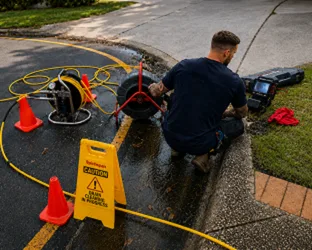
Per metre, with access and junction reinstatement itemised, and the excavation comparison alongside it so you can see both.
Clean, install, cure. One access point, one day for most homes, and no trench across the property.

Branches reopened, final footage, certificate and notification. Keep it with the property file, it is worth real money at sale.
Describe what the drain is doing and how often. We will tell you whether it sounds structural or whether a clean and a maintenance interval is the honest answer.
The questions that come up before every relining job, answered with real numbers.
Ring us or leave your details. You will get a time for the inspection, not a price invented over the phone.

Leave your details and our local Engadine team will call you back fast.